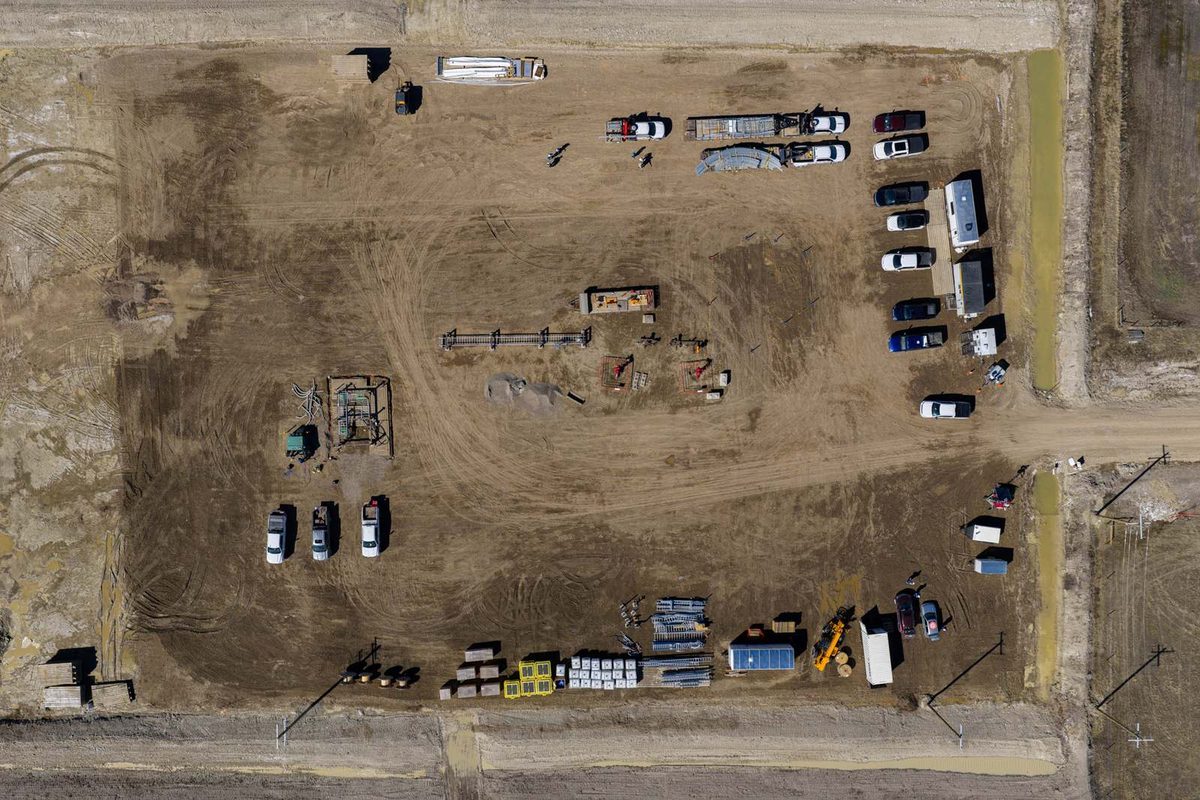
The first BURNCO truck reversed into the bay at 06:14 on a Thursday morning in southeast Calgary. The lights were already up, the crew was at the line, and the temperature inside was holding at 10°C. Outside it was below freezing. We had 4 days, 4 pours, 1 slab of 193,621 sq ft to film, and the placement clock had just started.
Elan Construction was placing the slab on grade for Starfield 4/5, an industrial building at 58th Avenue and 57th Street SE, the 4th of 5 buildings in the Starfield development. The pour was scheduled across 4 consecutive days at a planned rate of 100 m³/hr, with a daily ceiling of 1,200 m³ set by what BURNCO's plant could supply and what Dynamic Concrete's finishers could keep up with.
Andrew Desrosiers, Elan's Field Manager, brought us in to capture the whole sequence as one film. The brief was direct. Document the building's footprint, the choreography between Elan, Dynamic, and BURNCO, and the technical detail that separates a smooth pour from a rough one.
Day 1 looks different
I knew Day 1 wasn't going to look like the rest of the week. The intricate corner of the building had to be poured manually with a Line Dragon distribution system, a flexible hose fed from a pump truck out front, walked across the slab by a 2-person crew on foot. No laser-guided screed yet. Just hands, rakes, and discipline.
We shot the 06:00 tailgate meeting and stayed close to Paul Duggan, the site superintendent, while he walked the perimeter and called out the morning hazards. The temperature inside the building was holding at 10°C through sealed perimeter bulkheads and a completed roof envelope. Outside it was minus 8°C and snowing lightly.
Pour days have their own clock. Once the first truck dumped, the tempo set itself.
Site access and what we carry
We don't walk onto an active slab pour without ISN compliance, current PPE, and a safety orientation cleared by the prime contractor. We carry $5M commercial liability and a Transport Canada Advanced Operations pilot certificate for the drone work. The site brief covered hard hat, hi-vis and steel-toed boots. Paul recommended rubber boots given how wet the floor gets during placement, and we listened.
The camera bodies needed acclimatizing too. At 10°C indoor with crews tracking concrete in from the pour line, we kept Pelicans closed until each piece was in position. Lens condensation is the difference between usable footage and a wasted morning.