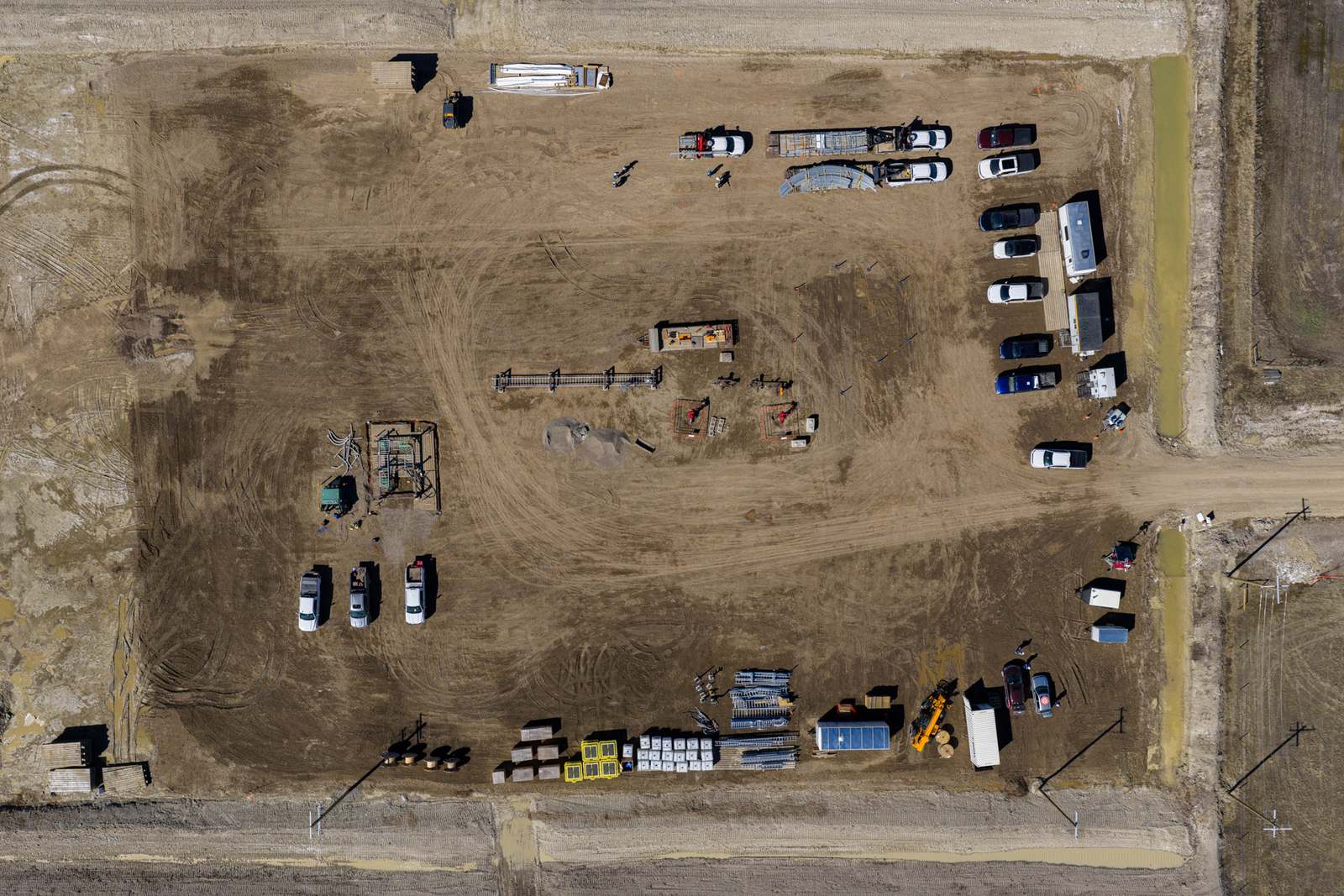
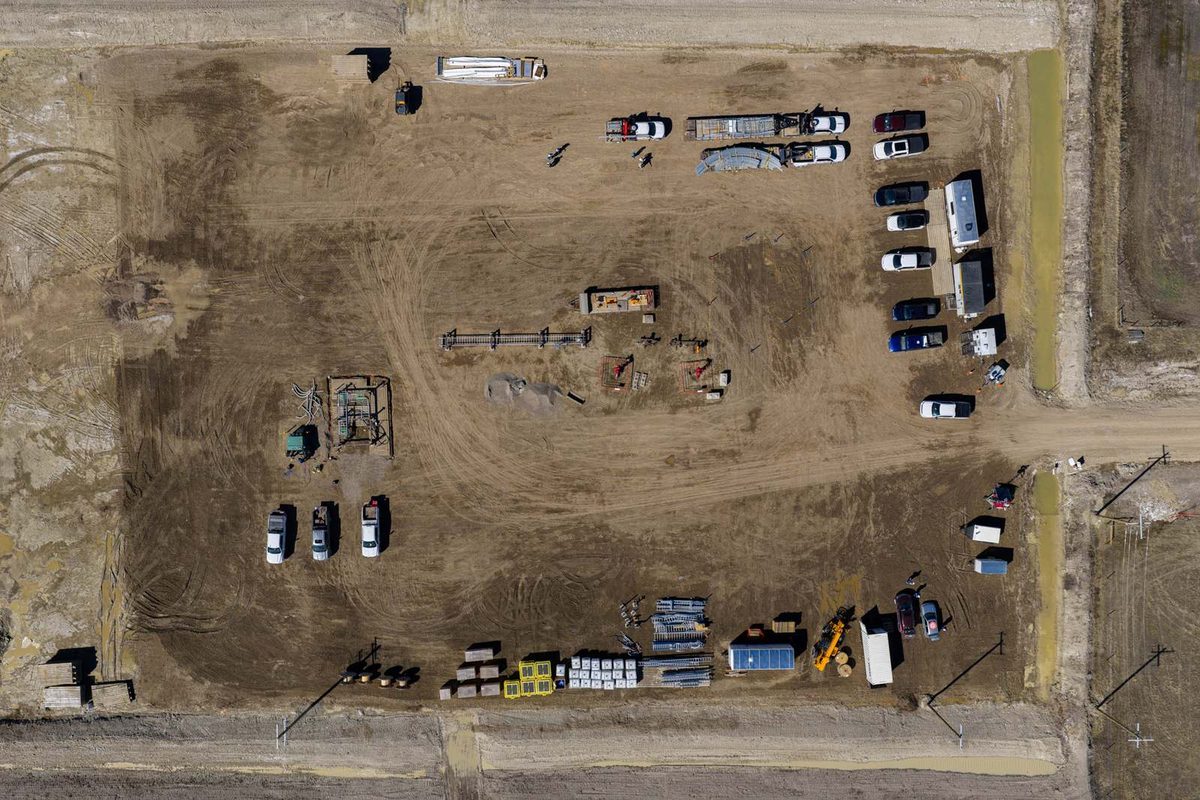
We put the drone up over a field near Olds at 11:38 on 20 April 2026, the day after the brief was signed off. What it photographed was mostly dirt: a graded pad, a laydown yard, a row of crew trucks, and trailers along the east edge. Nothing on that pad yet looked like the largest lithium resource in Canada.
That is the problem with documenting a first. The moment worth having on record is the one before there is anything to look at, and the only way to get it is to be there early and keep coming back.
The situation
E3 Lithium is proving Direct Lithium Extraction on Alberta brine, with commercial production on the Clearwater Project planned for 2028. The demonstration facility near Olds is where that gets proven or does not.
Jeremy Nichol brought us in as the facility came online. The brief asked for a permanent visual record of the moment it became operational, plus a library E3 could keep drawing on through the years between commissioning and production.
Underneath that was a harder ask: the origin story. Not the facility as it stands, but how it got there, which is a thing nobody can go back and shoot.
How we worked it
6 site visits, spread across the build rather than concentrated into a shoot week. A facility does not become operational on a single day, so the record of it becoming operational cannot be made in one.
20 and 21 April, 25 April, 1 May, 30 May, 5 June. Tight at the start, when the site changed fastest, then spaced out as it settled.
The first flight did the work that made the rest of them useful. We put waypoints in on 20 April so every later flight could be flown to the same marks, at the same altitudes, on the same headings. That turns 6 visits into 1 comparison instead of 6 separate shoots: the same frame, weeks apart, with foundations poured and wells drilled and tanks set between them.
Nick Keefe and Chris McElwee flew. I was on ground video and stills. We ran a ground time-lapse on 3 or 4 of the visits, pointed at whatever was most likely to look different by the next one.
By 5 June the work had moved to the ground. A 24 mm wide along the wellhead manifold at 10:32, a 74 mm frame of the dome and the wellheads at 11:49, crew in gas-monitoring gear at the edge of it. The fields had gone green since April. That change is the whole argument for going back.